Saturday, July 5, 2025

Castle Blackeagle Sessions 1-3


Never finished the writeup, but here's the take for the first expedition to the Dolmen of the Hounds: 

Foes Defeated

3 death-hounds, 3 berserkers, 1 adept of the horned ones

Treasure

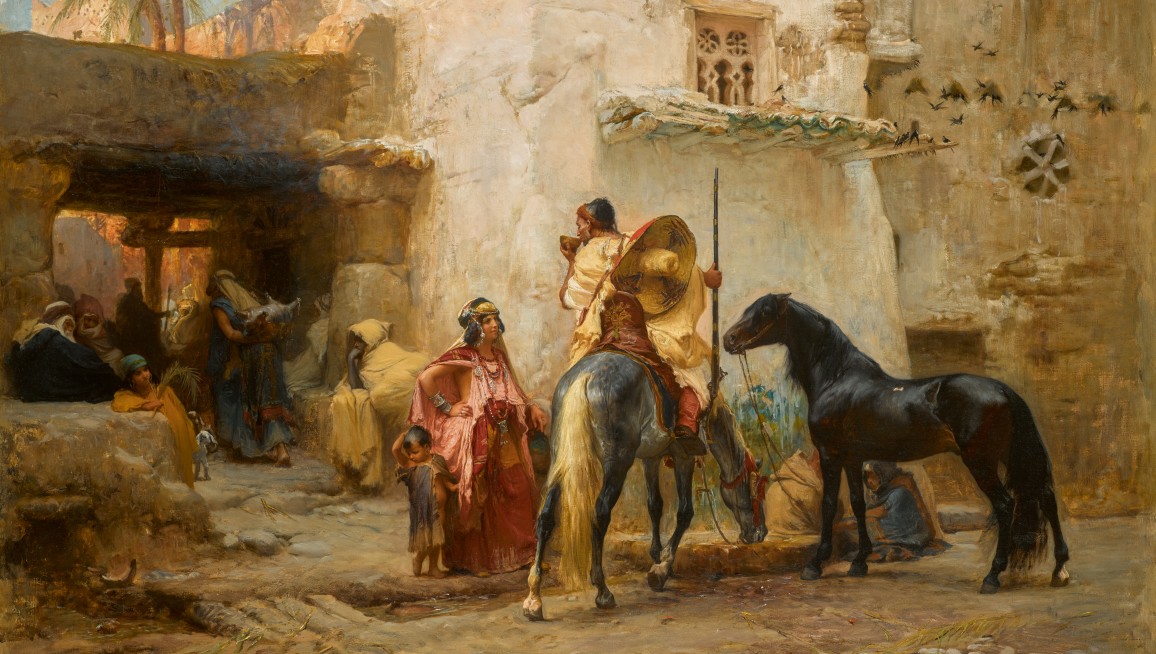
Adept's 'spellbook' of rune-scribed bones (requires decoding), gold-trimmed red cape of elven make (180 gp), chiton-style blue dress with rose-gold trim also of elven make (240 gp), white tunic of elven silk (120 gp), reddish-gold and silver bracelet (700 gp), silver zoomorphic brooch with an emerald gem eye (210 gp), figurine of a songbird wrought in silver with gemstones (450 gp)

XP per person

266 XP

Thursday, October 31, 2024

New Monster: The Schreckenkatzen

Hell-Cat
Spooky cat by Evlyn Moreau

Also known as a Cait-Scairde, the Schreckenkatzen is a lesser demon of hell which roams the dark places of the world, causing mischief, knocking over jars, stealing food, and devouring solitary travellers who they meet on lonely roads. While it may not be itself sighted often in the places it haunts, its presence is known through claw-scratches upon the doors of temples, hideous night-yowling, and the acrid scent of its oily vomitus spewed upon graveyards and other sacred places it seeks to defile. 

Armour Class: 3 [16]
Hit Dice: 6**
Attacks: 4 x claws (1d4) or vomit flames (3d6 + oil)
THAC0: 14 [+5]
Movement: 240' (80')
Saving Throws: D6 W7 P8 B8 S10 (10)
Morale: 5
Alignment: Chaotic
XP: 850
Number Appearing: 1 (1)
Treasure Type: I
  • Size and Reach: More liquid than even mundane cats, the Schreckenkatzen can fit through holes a mere 3" wide, but can also reach up to 10ft away with its claws.
  • Mundane Damage Immunity: Can only by harmed by magical attacks or weapons coated in silver.
  • Invisibility: When alone, or within an area of darkness, may become invisible (as the spell). May speak, interact with unattended objects or make a single claw attack without ending the invisibility. Rendered visible if damaged.
  • Disguise: May change appearance to resemble a normal black housecat, with the same conditions as Invisibility.
  • Purring Voice: Can attempt to charm any person who hears its voice. Targets must save vs spells or treat the Schreckenkatzen as they would a normal housecat. 
  • Fiery Hiss: Flare of yellow-green fire from its eyes and mouth causes fear (as the spell) in a 120' cone at will.
  • Coughing up Fire: Vomit up eerie yellow-green flames in a 90' long cone (save vs breath for half). Area covered with burning oil for 1d4 rounds after. 1/day, also recharges they eat a person.
  • Plays: Stalks victims and waits until an opportunity to strike. Captures unconscious victims to torment them later.
  • Catcher of Shadows: Any person of 2HD or more that the Schreckenkatzen kills whose remains are left unblessed by the next sunset becomes a Shadow in its entourage. Burning obviates this effect.
  • Lair: Also contains 1d4-1 Shadows. 


Sunday, July 14, 2024

New Monster: Steel Snails


(Picture from a post on Britain in detail: quirk, charm and craft in the built environment on facebook.)

 Steel Snail

A swarm of small, metallic snails that consume metals. Despite their name, their bodies usually resemble some patchy iron, but their actual composition depends on the specific metals they've been feeding on. They implacably slither towards any metal they scent, whether worn, held, or unattended.

They exude heat from small furnaces within their shells (where they digest the metals), which a whole swarm may release at once in response to danger (the equivalent to a heat metal spell applied to anyone within 10 feet of the swarm). They may do this once per day. 

A swarm that inhabits an area for a long time will gradually coat surfaces in a metallic patina with their slime trails. Fanciful tales from the East have wizards feeding them diets of precious metals to gild sculptures and scrolls with unique alloys. (And providing a smokeless source of heat.)

Given their composition and behaviour, most sages ascribe their origins to one of the paraelemental planes of existence, although this has not been satisfactorily proven in the Collegia Magna and a significant minority assume them to be sorcerous constructs. 


Armour Class: 5 [14]

Hit Dice: 2 to 4 (9 / 13 / 18hp)

Attacks: Special

THAC0: NA

Movement: 5’ (1’)

Saving Throws: D13 W15 P16 B17 S18 (NH)

Morale: 12

Alignment: Neutral

XP: 20 / 35 / 75

Number Appearing: 1 (1d3)

Treasure Type: Special

Size: 10’ × 10’ area, typically.

  • Immunity: Unaffected by sleep spells or damage from fire. Intense cold slows them as the spell. 
  • Swarm attack: Anyone wearing or carrying a metal object within the swarm must make a Save vs. Petrification. If they fail, they automatically take damage — 2hp if wearing armour, 4hp without — and the snails latch onto them, doing damage automatically while still attached. This damage is magical.
  • Heat Vent: Once per day, may vent heat en masse: as heat metal applied to everyone within 10 ft of the swarm. 
  • Consume Metals: Metals left in the swarm’s area over time will be consumed by the swarm, with small objects (e.g. thieves’ tools) consumed within 1 turn and any armour or swords consumed entirely within 1d6 hours. Magic items may save to resist as with Rust Monsters. 
  • Escaping: On exiting the swarm, characters continue to suffer half damage until a round is spent swatting off attached snails.
  • Pursuit: Snail swarms that scent metal within 60 ft will pursue it relentlessly.
  • Raw Materials: The snails’ value as metals depends on the metals they were consuming, but an “average” swarm is worth GP equal to its HP.


Friday, January 5, 2024

Free Hexmap Templates

Hey, with the #hexplore stuff going on I figured I should clean up and post some hexmap templates I've had sitting around for a while:


If there's any hexmap templates (or variations on existing ones) you'd like to see added, please let me know!

Friday, March 10, 2023

Two OSE Spells

A few years ago, when a Wilderlands campaign was being converted from 5e to OSE, I had written up two versions of spells my 5e character (a Tempest-domain Cleric) used a lot. It seemed weird to me for him to just stop casting the spell, so using existing previous-edition spells as benchmarks I converted them to this:

Thunderwave
1st Level Spell
Duration: Instant
Range: 15’ cone
A wave of thunder blasts creatures and objects in a 15-foot cone originating from the caster. Any creature in the area of the wave takes 1d4 points of thunder damage per caster level (maximum 5d4), with a successful save versus spells indicating half damage. Unsecured objects and medium or smaller creatures who failed their save are hurled 10ft away from the caster.

Shatter
2nd Level Spell
Duration: Instant
Range: 60’
An implosive wave crushes things within a 10’ radius sphere originating at a point within range.
  • Damage: Creatures and objects caught in the sphere suffer 1d4 damage per level of the caster (1d6 if they are made of inorganic materials), with a successful save versus spells indicating half damage.

Monday, January 9, 2023

Disconnected Thoughts on Running Medieval Settings

Reposting a reply to someone who asked for tips and advice running a Cthulhu Dark Ages game. These were written with the idea of a medieval mystery game in mind, but I think they apply equally to pretty much anything trying to capture a medieval vibe.

1. All institutions are persons. The level of bureaucracy and institutional inertia we're used to in the modern era could only be *dreamed* of. The rules are *never* blindly enforced, and the systems in place to argue about them are incredibly complex compared to our expectations. 

2. Labour is expensive, and preserving it is everyone's reflexive top priority. As much as the life of a peasant seems degraded to us, the entire system exists to keep people able to make food, and the margins for error for even a king are razor-thin compared to now. 

3. Points 1 and 2 mean everyone is very aware of their debts and obligations in keeping everyone around them alive, and their reliance on the fulfillment of those debts and obligations by others. If one person in a village dies, it's everyone's business.

4. The world is alive. This might seem odd, since we're not used to the idea of medieval Christianity as "animistic," but the reality is that the medieval mind treated the entire cosmos as hylozoic — they describe physics, geology, weather, everything in terms we would reserve for plants and animals. 

5. Life is mysterious, and mysterious forces surround everything. A tree grows from an acorn; a child from its mother; a corpse births the worms and flies of corruption. It is not weird to assume that a child born under a particular star-sign will have some traits, for the fixed and wandering stars scribe the cycle of the seasons themselves upon the heavens.

Thursday, December 29, 2022

Space23 Table Ideas

Someone was talking about alternatives to 'rooms' for an SF-based version of the dungeon23 project, so here's a table of options when you're out of obvious ideas:
 

Roll 1d6:
1. technological item.
(not necessarily a new technology, but an existing technology used in a setting-specific way. example: ferengi tooth-sharpeners.)
2. ideology. (a belief, either a whole structure or a common opinion or narrative about something in the setting, with an idea of who holds it and why)
3. accident or sudden event. (industrial accident, vehicle crash, disease, toxic chemical release, or just the result of systemic negligence.)
4. minor NPC. ('person-on-the street' npcs for various common locations --- starports, colonies, underhives, ancient low berth colony ships, etc)
5. cargoes. (something carried from one place to another, i.e. *why* a spaceship exists).
6. roll again: 1-4 non-intelligent life form and it's environment adaption/niche; 5 non-generalized robot (like an automatic checkout, roomba, or car assembly robot); 6 specialist program in starship/starport/local planetary networks.

Thursday, October 7, 2021

Colossi Takes (Sessions 1 - 4)


I should really be writing here more, given that I’m running two games. I somehow managed to post nothing for the entirety of 2020, but given that it was 2020, who could blame me? 

Anyway, here’s two session takes from Nightwick: Isle of Colossi, which I’ll explain at some point.

BEHOLD THE COLOSSUS (2 Sessions)
Present:
The Choir, the Llady, Sir Miquelo, Nestorios Parsimonios
Treasure: 2 gold collars (10 gp each), 2 gold armbands (30 gp each), 1 gold necklace (30 gp), 8 gold necklaces (8 gp each), 1 golden chain (60 gp), 1 jewelled golden belt buckle (80 gp), 1 ancient crown (250 gp), 1 mysterious reddish-copper circlet (magical?)
XP: 269 each.

THE NIGHT OF THE KNIGHTS (2 Sessions)
Present:
The Choir, the Llady, Sir Miquelo (Pt I only), Nestorios Parsimonios
Treasure: None
XP: 296, except for Sir Miquelo, who receives 142.

Saturday, December 21, 2019

Two Nightwick-Inspired Campaign Ideas

One of the challenges I often face when designing D&D campaigns is what I refer to as "the whole deal." Even if I'm starting a campaign with a small hexmap or a single dungeon, I get stymied when figuring out the rationale for default D&Disms like elves, orcs, and the various kinds of magic. I might post more about this later, but the TL;DR here is that, to solve this problem, I often develop campaign ideas starting from games I've played in. Here are two ideas I have that have originated with the Nightwick campaign run by Evan of In Places Deep.


The Corpse-City of Kar Hadash
Setting: The ruined city of Kar Hadash, on the coast of the Desert Lands, far southwest of Nightwick Abbey.
Vibe: Ruined city megadungeon in a late medieval southeastern mediterranean

Centuries ago, the Lawful Empire of Man invaded the isle later known as Zenopolis and deposed the cruel dynasty which was preeminent amongst the isle’s kings. The last survivors of the dynasty fled with their secret treasures across the sea to the Desert Lands. There, they founded Kar Hadash, the ‘new city,’ and brooded over their plans for revenge and supplicated their demonic masters for foul boons. It became a pirate port and den of wickedness renowned the world over. It is no wonder, then, that it was one of the first places laid waste by the crusading Sword Brothers.

For centuries afterward, the city was a charnel house and dwelling place of naught but ghouls, but now rumours of resurgent cults, strange prophecies amongst the desert tribes, and piratical pretenders to the ancient throne have drawn a new generation of crusaders and tomb-robbers to the dead city.


Raiders of the Lost Empire
Setting: Atalia, the Desert Lands, and isles of the Starry Sea ~1400 years before the Nightwick Abbey campaign
Vibe: Sword and Sorcery Rome in the age of the Crisis of the Third Century.

The revelations of the Empress have transformed the Empire. The miracles of those initiated by Gax Ovo have transformed the world. As those who hear the holy thrumming Law and those who hew to the Old Gods (and worse) split the empire in revolt and revolution, the ancient temples and nemetons of ages forgotten are ripe for overthrow and plunder. Noble zealots and ignoble vandals seek out the treasure-vaults of the Empire’s Old Gods — Orcus Oath-binder, Apollo Far-shooter, Hermes Soul-taker — and try to stay out of the way of the clashing legions of the riven Empire.

Saturday, October 5, 2019

Xothesque Adventurer Origins


The adventurers who delve into the mysterious Black Pharos come from to Yond on the continent of Gnydron from across the wide oceans. Roll 1d20 to determine where your character hails from:

Xothesque Origins (1d20)
1: Western Archipelago. Lying amidst the Black Current that flows between Zothique and Gnydron, these islands are inhabited by pirate clans, exiles from the mainlands, and hidden devotees of disreputable gods.
2: Naat, the Funereal Isle. The home of ancient orders of catacomb-dwelling monks, defending their charges against jungle-dwelling anthropophages.
3-6 Xylac. A breakaway maritime province of Cincor, whose mercantile triremes travel to all quarters of the world from the ports of Mirouane and Oroth.
7-9 Cincor. An ancient and shrinking empire centred on the tomb-girt plain city of Yethlyreom.
10-11 Ilcar. Northern Cincorcian suzerainty of rock-carven towns in mountainous plateaus.
12-13 Tasuun. Desertified remnant of the sorcerous empire of Ossaru, which once stretched to the western sea.
14-15 Yoros. Southern Cincorian suzerainty of warm, fragrant forests and wide, fertile river deltas.
16 Cyntrom. Large island of petty lowland kingdoms and fractious hill clans.
17-18 Calyz. A rich eastern kingdom ruled from the high-domed palaces of Shathair.
19 Far Isles. Fabled Uccastrog, Sotar, and other, legendary islands of the Orient Sea.
20 Stranger Lands. Gnydron is more subject to incursions of "outsideness" than any former terrene realm; and more liable to the visitation of beings from galaxies not yet visible; also, to shifting admixtures and interchanges with other dimensions or planes of entity.

Friday, September 27, 2019

The Red Manse of Oumkha

Those adventurers who seek the mysteries of the Pharos strike out from the Red Manse of Oumkha, a paltry oasis of humanity within the eerie vastation of Yond. Its crumbling reddish-ochre walls date from the rule of the devil-kings of the Pharos, when it served as the dwelling-place of some unknown viceroy, warlord, or hierophant. It is only one of the ruins ringing the outer approaches of the Pharos, but gained notoriety amongst the Yondorkandi as the dwelling place of the madman Oumkha, once apprentice of the doomed Arbaz who disappeared in the shadow of the Pharos.

A few years ago, the heterodox, vermillion-robed Daughters of the Maugourah came to reside there, beginning to clear the rubble and replace ruined stone with wood and brick. The sisterhood persevered in the midst of the prowling horrors of the wastes, and since then, the Red Manse became a stopping-place for the exiles and wanderers who people the region, eventually taking on the quality of a small market village.

More recently, a soubashi of the far city of Aburuz has arrived with a troop of guards, dispatched to assert the authority of that city over the settlement of the Manse. He wisely does not press the issue with the locals, and spends most of his time in some (relatively) palatial tents outside the Manse.


The Manse itself is built around two courtyards. The southern, fountain courtyard is where newcomers water their animals, and is overlooked by the apartments converted into the House of the Magourah. This section, except the old shacks clustering around the south side of the House, is closed to outsiders. The northern market atrium, once a tiled garden, is now filled with the tents and shacks of scavengers and craftsmen.

The manse is bisected by a large passageway, connecting the fountain courtyard to the market atrium and the road north, and a smaller passageway east to west, dividing the market atrium from the house of the Magourah and fountain courtyard.

A berm of rammed earth stretches to the west, remnant of some fortification from past ages of Yond. The Soubashi’s tents are northeast of the market atrium, along with the ruder dwellings of the cactus-gatherers, hunters, and smiths.


Most of the population of the Manse is temporary — beggars, exiles, heretics, escaped slaves, refugees of war, criminals fleeing the law, muck-farmers, mushroom-gatherers, hunters, scavengers, dust-sifters, dew-collectors — but a few personages stand out as more constant dwellers in the Manse’s walls.

  • Sister Ouahaub is the public face of the Daughters of the Magourah, and assumed by most outsiders to be their leader. She is the one who handles the money, goods, or services the sisters charge for stays in their simple shacks.
  • Sister Amuathah is a cheery, punctilious old woman who dispenses poultices and other medicinal remedies to locals and visitors. She is frequently seen in Vosseion’s company, presumably because of the overlap in their professional interests.
  • The Soubashi is a flighty, paunchy man who was dispatched from the far city of Aburuz to ensure the dwellers of the Manse pays the Vizier their due, he has so far failed to make strong headway in the taxation department. He seems more interested in purchasing artefacts dug up by from the surrounding area.
  • Youb the wine-seller is a sun-shrivelled old man clad in faded and threadbare finery, who imports wine and other liquors from New Yondorkand, Aburuz, the nearer coasts of Cisyondic Gnydron and beyond. His product being universally popular, he often accepts payment in goods and services from the nomadic wastelanders.
  • Vosseion the apothecary, shisha-monger and tea-seller is Youb’s counterpart as another purchaser of exotic flora gathered by the wanderers of the wastes. He wears only plain black silks, and entirely depilates his pallid skin.
  • Nabrarzha the smith is a grizzled, scarred, one-eyed, seven-fingered woman who works with metals and gems. It is an open secret that she fled from the torture chambers of New Yondorkand, where she was imprisoned at the Hierarch’s pleasure over an aesthetic disagreement regarding her sculptures.
  • Among the muttering priests, fakirs and holy women who sell charms and prophecy in the market are the handful of shrine-keepers of Yugla, the ugly, laughing beetle-god. Colourful sacred beetles are fed with choice cuts of meat to gain Yugla’s favour, and their divinatory movements amongst the scattered offerings of petitioners are interpreted by the shrine-keepers in response to petitioners’ questions.


Rumours (1d20)

  1. The Red Manse is not the only ruined villa nearby. Some are nearly intact.
  2. The Pharos mutates those who linger under its mauve glow; everyone in the the Red Manse will be beast-men ere long.
  3. All the expeditions to the Pharos are cursed; those who ‘return’ from the Pharos are demons in stolen faces.
  4. The thearchs of Ong plan to conquer Yond; their spies infiltrate the Manse and New Yondorkand.
  5. Soon, the Hierarch of New Yondorkand will march on the Manse and kill them all.
  6. The food harvested from the mushroom forest to the northwest turns men to beasts.
  7. No natural beasts reside in the wastes; all are accursed former humans.
  8. The Hierarch of New Yondorkand is a demon in human guise.
  9. There is a great city of beast-men to the north. They are preparing to march on the Manse.
  10. The ancient Crown of Yond resides in some hidden tomb, still worn by the true ruler of this land.
  11. To the west is a crack in the earth which falls away into the starry sky.
  12. The Daughters of the Magourah abduct people in the night to be their lovers and slaves within hidden chambers of the Manse.
  13. The Daughters of the Magourah are the disguised handmaidens of a princess of Bel-Nahath, fled from the thearchs of Ong.
  14. Great bats fly out of the Pharos to feast on the psychical essence of humans.
  15. The Magourah is in fact a lamia, driven out of the Pharos by the inquisitors of Ong. The daughters are her mesmerized cohorts.
  16. The Pharos marks the place where the gods had wrought the world, the axis mundi, and birthing-place of Veragammata Phanes, mother of the cosmic egg.
  17. The Pharos is the tomb of Thasaii, dark god of Old Yondorkand. His devotees still hide among the peoples of Yond.
  18. The Pharos is the tomb of Thasaii, euhemerized king of primordial Yond, slayer of the dragon Thaumogorgon.
  19. The Pharos is the wick of a strange living flame that resides deep within the earth.
  20. The light of the Pharos is the lantern-light which projects the shadow-puppets of mundane reality.

Saturday, June 8, 2019

Autopsy Report on an Equine Cadaver


On my last post, someone asks:

I'm curious, as I wasn't around back then- what happened in 2013 that makes you consider that about the time that the OSR died?


I peg it at 2013 because of a number of trends, most of which intersect with the mass movement to G+ space (and the forced integration of G+ and blogger) by OSR participants. 

1. Blogs.
The rate of blogging was falling dramatically in favour of G+ posting. And, by this time, many core OSR blogs and their associated communities, and blogs as a means of communicating between bloggers, had either stopped (a la Grognardia in 2012) or disappeared (a la Eiglophean Press in the late Triassic). The ones that kept posting tended to degenerate into clickbaity content-grinding (like endless d100 tables du jour or Zak’s Fiend Folio bullshit). This is partially driven by…

2. Monetization. While other people (cough Miranda cough) have strong feelings on the aesthetics of the monetization of OSR blog material, I don’t really have a problem with it, but the move from posting, discussion and criticism to aggregating, publishing, and promoting dramatically changed the tone and quality of OSR discourse. Around 2013 "OSR" became a promotional term to stick on your PDF or KS to sell to the preexisting audience of blog-readers.

For one thing, tons of people seemed to shift into Consumer Mode at the drop of a hat, even when it was at odds to the very point of the shit they were reading up to that point. The central event here is everyone getting their jimmies rustled for a Dwimmermount book, despite Maliszewski specifically saying that published megadungeons are bound to disappoint. And then when real life intruded on the (too optimistic) KS schedule, some people started flipping out and shitting on Maliszewski personally. Then someone started bitching about round numbers of coins in rooms, proving Maliszewski right… 

You can call someone’s blog post crap (and explain why) and still be friends or respected colleagues; but doing a bad review of their product (and explaining why it is) takes money (theoretically) out of their hands, hanging a sword of Damocles over presenting anyone’s real thoughts about anything publicly. And people care about this more because…

3. Socialization. The faster pace of G+ commenting and the face-to-face communication of ConstantCon exposed much the community to more intimate scrutiny of itself than before, stripping away the emotional distance of blogging and replacing it with the awkwardness of actual speech. By 2013, what previously had been a community linked primarily by blogrolls had become more discrete sub-communities based around playing in weekly games with mostly consistent player-bases, which sorted themselves according to subsets of interests, personalities, and politics. Ideas which previously were written up in blog posts become bullshit you said at 2am to 1d6 randos across the globe. 

4. Politics. (All kinds).
With exposure to more people in more frequent and intimate ways, things about each participant in the community that never really came up in (most) blogs started to become obvious to the other participants, and around this point most people started dissociating themselves with large sections of the community based around political views — both ‘regular’ politics and internal scene politics. (I had a list of examples here, but it infuriates me still to recount them, so I will leave them mouldering in G+'s grave.) A year later, the intersection of external politics, internal politics, and another scene's internal politics gave rise to greater actual stakes for all of it. 

Thursday, June 6, 2019

The OSR Is A Dead Horse

The OSR as a single, coherent community died around 2013. It was never a coherent philosophy or genre. "OSR" is now a meaningless brand identity, like "green" or whatever. Any communities that exist now are not OSR, but post-OSR, and if the members of any such post-OSR communities participated in the OSR before it died they, generally speaking, hate large swathes of the rest of the former OSR community. If they don't, they weren't there, like the reverse of Woodstock except in this metaphor there was no Woodstock, just Altamont.

Any attempts to "rename" the "OSR" is missing the point. Either it's trying to find a new brand identity to grind into the dust of meaninglessness, or just trying to ride a dead horse.

Tuesday, March 5, 2019

Caves of Chaos Restock — Part One: Everything (Part Two)


This is the second half of our first step in restocking the Caves of Chaos. You can read the first half here.

Last time, we established who or what built, used, and inhabited it in the past. Now, we begin to establish who or what inhabits it now.

Again, we want to preserve the basic point of the Caves, where the players explore the territory of a variety of foes, some of which are allied with the inhabitants of other caves, and which present a variety of challenges to the players.

Using the Red Box monster list as a suggestion, and guided by the previously-established history, I've started to flesh out the inhabitants at the most basic level:
  • A - Fungi/Giant Bugs
  • B - Ghouls
  • C - Goblins
  • D - Goblins
  • E - Special
  • F - Orcs
  • G - Special
  • H - Wizard and Minions
  • I - Oozes
  • J - Cultists
  • K - Elves

I've chosen this mix to include both "regular" humanoids, undead, wildlife, and a couple of "specials." This should make some of the areas of the cave both feel different and present different kinds of challenges to the PCs.

In order to underline and complicate these differences, i'm also going to relate certain caves to each other factionally. These relationships will be more obvious than in the original version, and hopefully offer more choices to the PC when it comes to allies of convenience or sources of information. These faction-relationship will form the other half of the 'story' of the dungeon as it changes in response to PC actions.

Each faction is first formed by connecting areas to each other:

A - Fungi/Giant Bugs - Purple B - Ghouls - Orange C - Goblins - Green D - Goblins - Purple E - Special - None F - Orcs - Orange G - Special - None H - Wizard and Minions - Green I - Oozes - None J - Cultists - Orange K - Elves - Purple

This provides us with the following factions and sub-factions.

  • Faction One (areas K, D, A): The elves, goblins, and their fungi
  • Faction Two (areas J, F, B): The cult of Orcus, the orcs, and ghouls - J, F, B
  • Faction Three (areas H, C): The wizard and goblin minions - H, C
  • Faction Four (area E): Special
  • Faction Five (area G): Special
  • Faction Six (area I): Oozes

With these relationships in mind, we can also start to flesh out our ideas about what each group is like. I’m going to start just with an evocative name that suggests evocative imagery:

  • A - Fungus Garden
  • B - Shadow Ghouls
  • C - Clan of the Pallid Eye
  • D - Redcaps Clan
  • E - “Ghosts”
  • F - Bonesplinter Cadre
  • G - Aged Lamia
  • H - Arch-inquisitor of the Pallid Eye
  • I - Pit of the Oozes
  • J - Cult of Orcus
  • K - Deep Elves

These links will, of course, change over time. Most obviously if one part is wiped out, but also in response to stress or the movement of other factions or other unusual circumstances. If the goblin chief is killed, perhaps the remainder may ally with the other goblins instead of remain loyal otherwise. The wizard may cut a deal with new groups to serve his ends. Oozes might feed on carrion left in an emptied area and colonize it as well. Et cetera.

Next time we'll start stocking the caves themselves, starting with... outside the caves.

Wednesday, January 30, 2019

Jump Drives in Traveller - An Illumination

This post grew out of discussion with certain others about handwavium technologies in RPGs, with a specific focus on interstellar travel constraints in Traveller. As someone who is always interested in how genre constraints are perceived in-character by PCs, and who was weaned on robust technobabble, I wanted to try to address the operation of the default Traveller jump drive. This is written without reference to OTU assumptions, working mostly from the relevant pages of the LBBs. 

If anyone has any critiques of this description in relation to the mechanics of the LBB jump drive, let me know in the comments.


When activated, the jump drive produces a bubble of ‘realspace’ within jumpspace, and in forming the bubble imparts to it the mathematical equivalent of a ’ballistic trajectory’ in reference to realspace-jumpspace coordinate correlations. By way of analogy, the jump drive is like a nuclear pulse rocket, using a single release of energy to lift off from the surface of a planet. Following this analogy, the fuel consumption and gravity-well distance is the minimum necessary to achieve realspatial ‘escape velocity’ for the jump-bubble. Because the formation of the jump-bubble occurs while the ship is in reference to realspatial coordinates, the course must be plotted before the activation of the jump-drive. No means of affecting the trajectory of the jump-bubble from inside, once created, is known, although research continues. (This may have something to do with causal issues related to the realtemporal-jumpspatial issues described below.) A major part of the trajectory calculation requires the jump-bubble’s surface to collapse, ‘re-entering’ realspace, in relation to the energetic level of the bubble at the moment of intersecting with gravitational warping of jumpspace — hence the ‘empty space problem’ of navigating without relation to gravity wells, and the requirement to climb out of a gravity well to form a jump-bubble.

The bubble’s extent in realspatial dimensions is related to ship size, but jump-capable ships currently require a minimum of 100 tons of displacement (although this is likely to be a constraint of power and fuel needs in relation to materials engineering rather than jumpspatial physics). The bubble’s minimum extent in realtemporal dimensions is subjectively between 150 and 185 hours (approximately 605 000 seconds, on average). The temporal size of the bubble appears to be related to the minimum density for realspace bubbles within a jumpspace ‘medium’; decreasing subjective jump time would require a method of adjusting realtemporal density without risking the bubble’s jumpspatial surface tension. (Given the time spent in the jumpspace bubble during a misjump, it is possible there’s an inverse relationship to realtemporal ‘density’ and jump-bubble surface tension.) It’s often assumed that the time spent in jumpspace also corresponds to travel time ‘within’ jumpspace, but the lack of ability to perceive jumpspace except as a theoretical mathematical construct means that this is likely to be a mere projection of sophont realspatial assumptions.

Sunday, November 18, 2018

The Aglaeca Stalks Again


Buried under fields, entombed in roots, or burbling under marshes, lurks the aglæca...
A new creature for your D100 or GUMSHOE-based horror mystery RPGs. The Aglæca is a beast out of the mists of folk-legends and grandam's fireside tales, an eater of children and king of the wastes. 

This PDF includes:
  • Stats for the Aglæca for both percentile-based RPGs and the GUMSHOE system. 
  • Variations and echoes on what the Aglæca is and where it comes from, and scenario seeds for placing it in your game.

The Aglæca has been revised and rereleased on RPGnow/DriveThruRPG as a pdf.

Saturday, November 17, 2018

Caves of Chaos Restock — Part One: Everything (Part One)


To begin, we have to establish two sets of facts about the Caves: 1. Who or what built, used, and inhabited it in the past, and 2. Who or what inhabits it now.

To preserve the central premise of the Caves, I'll continue to assign each area to different, mostly-mutually-hostile factions. This both produces variety, and explains why there isn't an effective defense against PC incursions into the Caves.

Some of the history should tie into why the current inhabitants are there, but some should be new arrivals as well, and each faction requires some sort of goal that they purse in the Caves. 

History of the Caves
For this exercise, let us assume a world that is broadly the same as the Red Box presents it — there is a human civilisation, somewhere, but it is not here. Elves, dwarves, et cetera live in small clans and  feud amongst and between themselves. Orcs and goblins are less friendly than the elves and dwarves, but possess their own societies as well. This should inform the situation locally, in the Caves.

To start with, let's say the Caves were built by elves, the oldest civilisation. Their original purpose were as tombs, rock-cut tombs set into an old gully. Because the exterior of the Caves are somewhat nondescript and a little boring, let's add some sort of fantastic detail to liven it up and try to communicate the idea that it was created by elves: the stump of a giant, petrified tree at the top of the gully (roughly above area XX). Petrified roots stretch across the sides of the gully, and the doors to each area are built into the negative spaces. The doors of each area are carven trilithons. This might mean that the first chambers of each area are the oldest, although the shape of most of the Caves (especially the north and south areas) implies whole sections were constructed at once. Conversely, Areas I and X might never have been deliberately excavated at all.

The monumental nature of the tombs implies that they were made for important people, and perhaps to commemorate those who died in some monumental battle or from some notable dynasty. We can put aside the specifics thereof until later, but we should keep that in mind while stocking decorative elements and specials.

To fill in the history of the Caves, post-construction, we'll layer on strata of occupiers, each having put their own mark on the complex. I'll leave aside describing the process of brainstorming these specifics, but in general I want a history of conflict and different reasons for occupation, in order to create the groundwork for justifying different factional interests in the Caves:

The Caves were first excavated by elves as a tomb complex. Later, they were occupied by a cadre of dwarves, who defiled and expanded them during their ancient wars with the elves and goblins. The dwarves, too, were killed and driven out by orcs and goblins, who then occupied the caves before being driven out by other clans. The Caves exchanged hands many times in the long, dark ages since then. The death-energies of the place attracted undead, diabolists and necromancers, but their hold on the Caves have been broken by the recent return of a secretive elven cabal. 

Next time, we'll figure out the large-scale question of who's in what area of the Caves, and how those areas interrelate with each other. 

Saturday, October 20, 2018

Random Vessel Generator


This is a sequel post to the Random Colony Generator from way back in 2012.

[A] [B] [C], troubled by [D].

A — condition
1: sleek and brand-new
2: well-maintained
3: beat-up and rugged but functional
4: ramshackle
5: broken (roll twice on Trouble table)
6: fragmented (roll 1d6 for number of pieces, roll on the trouble table for each section)

B — Size
1: Up to 20m (Examples: Soyuz capsule, Huey helicopter, Spacelab)
2: 20m to 50m (Examples: C-130 Hercules, Space shuttle orbiter)
3: 50m to 100m (Examples: C-5 Galaxy, Boeing 747, Antonov AN-225 Mriya)
4: 100m to 200m (Examples: International Space Station)
5: 200m to 500m (Examples: Nimitz-class aircraft carrier)
6: 500m or more (Examples: Burj Khalifa hotel)

C — Type 
1: Space Survey (Examples: astronomical surveyor, space anomaly investigation, navy scout ship)
2: Planetary Survey (Examples: terraforming surveyor, prospector, biological surveyor, xenoarchaeological excavation, army scout ship)
3: Passenger transport (Examples: liner, colony ship, refugee transport, snakehead smuggling ship)
4: Freighter (Examples: courier, free trader, bulk freighter)
5: Military (Examples: patrol ship, search-and-rescue vessel, weapons platform, drone carrier, assault craft)
6: Station (Examples: refueling station, trading post, communications relay, defensive outpost, navigational buoy, sensor array, orbital habitat)

D — Trouble
1: Lack of resources. (Examples: leak in fuel, fuel made useless through radiation or contamination, trapped in an area where solar power or other resource cannot be gathered)
2: Control system failure. (Examples: computer malfunction, navigational malfunction, remote-operation input malfunction)
3: Power failure. (Examples: power generator failure, engine failure)
4: Life-support failure. (Examples: cryotubes killing crew, cryotubes not opening on time, atmospheric integrity loss, failure of quarantine procedures)
5: Primary mission system failure. (Examples: weapon system failures on a military ship, sensor system failures on a deep space probe, cargo containment failures on a freighter)
6: “Nothing.” (Or, roll again for incipient failure, or roll on the Black Stars Hang trouble chart)


Wednesday, October 3, 2018

Caves of Chaos Restock — Part Zero

Despite its place in the pantheon of early D&D modules, and its almost-platonic structure (home base, wilderness map with keyed and unkeyed sites, leading to a large dungeon), B2: Keep on the Borderlands falls down in the dungeon department. While the map is intriguing, and the immediate branch-point of up to eleven possible directions to explore is a more initially-impressive situation to present to players than you get with most dungeons, the content itself sticks close to the idea of D&D as a tactical wargame, presenting you with a number of areas primarily inhabited by humanoid aliens who are distinguished only by their HD. The fantasy element is rare here — only showing up in certain treasure items, a couple oozes, one irritating magical hazard, and then some evil cultists and undead at the presumed end.

Whether I’m just a jaded millennial bereft of the sense of simple wonder of fighting ‘bugbears’ and ‘gnolls’ that nerds revelled in in 197whatever, or whether it’s just not a great dungeon, I’ve long mulled over doing something ‘in dialogue’ with the Caves of Chaos. The first version of the project appeared here as ‘Chaos on the Old Borderlands,’ material from which I’ve reused for my current Elderwold campaign (sans the Keep dungeon). Recently, inspired by Dyson’s completed redraw of the caves and rereading some old Alexandrian posts, I decided to try restocking the caves into something a little closer to my particular D&D interests.

The first step is refreshing my memory of how the areas are separated, and what their contents (mechanically) are:

A — Kobold lair: 38 HD
B — Orc Lair: 23 HD
C — Orc Lair: 20 HD
D — Goblin Lair: 34 HD
E — Ogre Cave: 4 HD
F — Hobgoblin Lair: 57 HD
G — Shunned Cavern (owlbears and oozes): 14 HD
H — Bugbear Lair: 54 HD
I — Caves of the Minotaur: 24 HD
J — Gnoll Lair: 58 HD
K — Shrine of Evil Chaos: 121 HD

Again, you can see how the majority of these dungeon zones are distinguished thematically by political divisions rather than landmarks, environmental conditions, differing ecosystems, magical effects, aesthetics, etc.

I haven’t done the math here, but just eyeballing the sheer number of rooms with monsters in them is way over the B/X stocking recommendations. I think the first thing I’d do, before changing anything else, is cut down the overall number of encounters (and probably reduce the total HD per zone, unless I were running it for a higher-level party).

 While the idea of factional differences as well as zone themes isn’t one I want to wholly discard, I think its important to tie them together and add in mechanical differentiation, plus the kind of details that makes exploration in D&D an intrinsically enjoyable part of the game (rather than simply a precursor to tactical engagements).

Next time I’ll address the thing B2 completely leaves out — the history of the dungeon — and make some decisions as to new zone themes.

Saturday, July 28, 2018

Elderwold - The Preamble


Here's the preamble I read to new players in the face-to-face campaign I'm currently running. This campaign is reusing some of the Chaos on the Old Borderlands material previously posted on this blog, but adapted to an earlier-medieval type of milieu. 

Though the setup is a D&D-style sandbox, we're using a once-'lite' fantasy heartbreaker system that's a little bit BX, a little bit Traveller, a little bit BRP, a little bit WFRP. As it gets playtested, I might start releasing it publicly, though in what format I haven't decided.


Elderwold

You’ve come to the town of Caradoc Howe in the North Marches to seek glory and fortune. It is a small fortified hilltop town within sight of the edge of the vast, foreboding forest called the Elderwold. Hunters, trappers, loggers and fishers brave its dark bowers to bring its bounty back to Caradoc Howe. To the south of the town are a scattering of small farms, made up of doughty freeholders and serfs whose fate it is to risk the predation of goblins, orcs, and elves.

Caradoc Howe is nominally the responsibility of Lord Gerhart, member of the House of Chlodomer and cousin and vassal to the Earl of Harthach, Marcher Lord, but practically Abbot Lonan of the small cloister of Apollo Belenus takes on much of the active duties of town management. The Abbot also takes on the responsibilities of high priest for the settlement, over the objections of Father Adhemar of the small Temple of Juno Augusta.

Nearby settlements are Cenwyn’s Ferry, Castle Harthach, and the hunter's camp and the fisher's camp a day's travel into the Elderwold. The ruins of the old Abbey of Apollo Belenus lie southwest of Caradoc Howe and northwest of the Castle (Abbot Lonan being one of the monks from that accursed Abbey), and the ruined pile of Castle Trowgate looms in the hills to the east lies near the Old Road that leads to the dwarf-halls of the Trowmoors.

History

The North Marches are the northernmost extent of the Great Kingdom, which, despite its name, is currently ruled by the High Regent. The Regent and the order of warrior-monks who enforce her will — the Templars — seized the Leaden Crown during the tumult of the Princes’ War a generation ago, when competing heirs, orcish invaders and other, darker crises threatened to destroy the realm of Law. Since then, she has ruled with an iron hand.

Most of the Great Kingdom’s population lives in the long-settled and temperate southern half, but land clearances and an organized system of fortified settlements to the north-west have brought forth more food and a power-base of those ennobled by the Regent’s land grants. These settler-nobles are the rough-and-ready nouveau riche of human civilisation, always looking for a leg up on older, established, pre-Regency noble families and new places to expand to.

Castle Blackeagle Sessions 1-3

  Never finished the writeup, but here's the take for the first expedition to the Dolmen of the Hounds:  Foes Defeated 3 death-hounds, 3...